
The Ego Problem: When the Organist Becomes the Star of the Service
Feb 23, 2026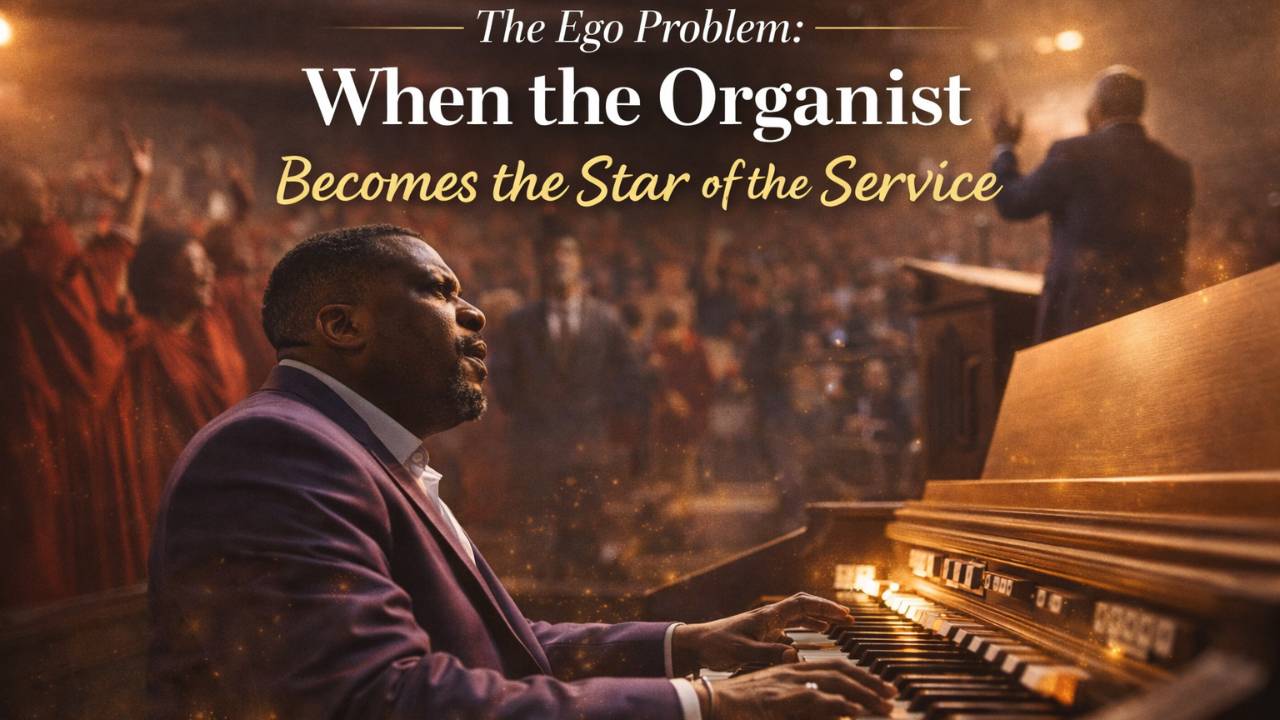
The church organ is powerful.
It can lift a congregation.
It can shift an atmosphere.
It can support a choir into transcendence.
But when misused, it can also overpower everything in the room.
There is a quiet tension in many churches that no one talks about openly:
What happens when the organist becomes the star of the service?
When Expression Turns Into Exhibition
Let’s be clear — expressive playing is not the problem.
Gospel music thrives on emotion, movement, and dynamic musical expression. Runs, swells, transitions, and modulation are part of the culture.
But there is a difference between:
-
Supporting the moment
and -
Hijacking the moment
When every vocal phrase is filled with unnecessary runs…
When the volume buries the lead singer…
When transitions stretch longer than the message…
When applause becomes the goal…
The focus quietly shifts from ministry to performance.
The Fine Line Between Anointing and Attention
Organists often carry immense skill. Many are classically trained, deeply experienced, and spiritually connected to what they play.
But skill without restraint can become distraction.
Anointing enhances the service.
Ego competes with it.
The congregation should feel supported — not sonically dominated.
Overplaying: The Hidden Confidence Issue
Here’s a truth that may surprise some:
Overplaying is often rooted in insecurity, not confidence.
Sometimes musicians overplay because:
-
Silence feels uncomfortable
-
They fear being overlooked
-
They equate busyness with excellence
-
They feel pressure to “prove” their worth
But true musical maturity understands space.
Silence is powerful.
Restraint is powerful.
Listening is powerful.
The Organist’s Real Role in Worship Flow
An effective church organist is not a solo act.
They are:
-
A musical architect
-
A dynamic supporter
-
A tonal guide
-
A servant-leader in sound
Their job is to:
-
Elevate the choir
-
Strengthen the soloist
-
Undergird the preacher
-
Shape transitions without stealing attention
When the organ dominates, worship flow suffers.
When Applause Becomes the Motivation
There is nothing wrong with appreciation.
But if the primary feedback loop becomes applause instead of impact, something shifts internally.
Ask yourself:
-
Am I playing to move hearts?
-
Or am I playing to move hands (clapping)?
Those are not the same goals.
The Healthier Standard
Healthy church musicianship requires:
-
Volume awareness
-
Dynamic control
-
Sensitivity to lyrics
-
Collaboration with the director
-
Emotional intelligence
The strongest organists are not the loudest or fastest.
They are the most aware.
A Word to Choir Directors and Pastors
This conversation isn’t just for organists.
Leadership sets tone.
If the culture rewards:
-
Flash over flow
-
Volume over sensitivity
-
Hype over harmony
Then musicians will respond accordingly.
Healthy worship culture is built intentionally.
Final Thought: The Instrument Is Powerful — So Use It Wisely
The organ is not the enemy.
Ego is.
When the organist understands their role as a servant of the moment rather than the star of the moment, everything changes.
The choir sounds fuller.
The singer feels safer.
The preacher flows easier.
The congregation connects deeper.
And the music becomes what it was meant to be:
Supportive.
Intentional.
Transformative.
Not competitive.