Is Your Music a Bridge or a Barrier?
Mar 25, 2026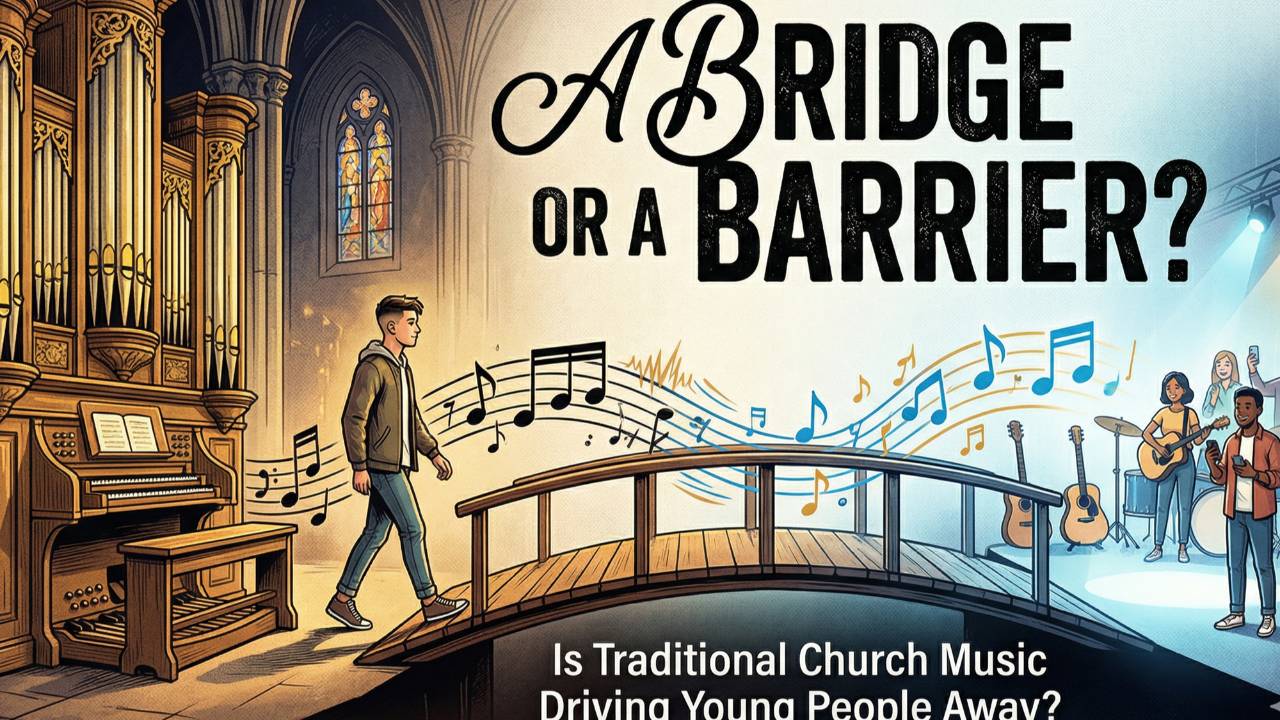
The air in the sanctuary is still, the stained glass casts long patterns across the pews, and then it happens—the pipe organ roars to life. To some, that sound is the very definition of "sacred." It’s majestic, it’s historical, and it feels like the voice of God.
But look at the back three rows. Or rather, look at the absence in those rows. For a generation raised on Spotify, synthesizers, and immersive audio, that same majestic organ doesn’t sound like "sacred"—it sounds like a museum.
It raises a painful but necessary question for every church leader and member: Is your music a bridge to the next generation, or is it the very barrier keeping them out?
The Comfort of the Familiar
We often confuse "reverence" with "what I grew up with." There is a deep, psychological comfort in the hymns of our youth. They anchor us to our history and our families. But we must be careful not to turn our musical preferences into an idol.
If we argue that God only speaks through a 17th-century pipe organ or a 1940s hymnal, we are inadvertently putting God in a box. The Bible is full of "new songs," and throughout history, the Church has always adapted its "sound" to reach the culture of the day.
The "Dead Language" Problem
Imagine walking into a church where the entire service is conducted in Latin. You might find it beautiful or "classy," but you wouldn't feel connected. You wouldn't feel like the message was for you.
For many young people, traditional organ music is a dead language.
- It’s culturally foreign: It’s not the "native tongue" of their daily lives.
- It’s emotionally distant: Modern music is built on vulnerability and intimacy; traditional organ music is built on distance and awe. Both are valid, but only one feels "real" to a generation craving authenticity.
The Mission vs. The Museum
A museum is designed to preserve the past. A church is designed to reach the future.
When a church refuses to evolve its sound, it sends a subtle but powerful message to the community: "This place is for people who like the past. If you belong to the present, you don't belong here." We have to ask ourselves: Are we more committed to the instrument or the mission? If the "bridge" we are building is made of stone and heavy wood that no one under 40 wants to cross, we aren't building a bridge at all—we’re building a wall.
Finding the Middle Ground: The "Both/And" Solution
Moving forward doesn't mean we have to set the hymnals on fire. It means we have to lead with hospitality.
- Mutual Honor: What if the "traditional" service incorporated modern textures, and the "modern" service honored a classic hymn with a new arrangement?
- Focus on the Heart: At the end of the day, a drum kit can be just as "performative" as an organ. The goal isn't just "cool" music; it's accessible music.
- Ask the "Why": Why do we use the instruments we use? If the answer is "because we've always done it," it's time to re-evaluate.
Final Thought
The Gospel is timeless, but the delivery of the Gospel must be timely. If our music has become a barrier, we are placing a stumbling block in front of the very people Jesus told us to go and find.
Is it time to trade your comfort for their connection?