Are Some Church Organists Musically Stuck in 1995 — or Earlier?
Mar 02, 2026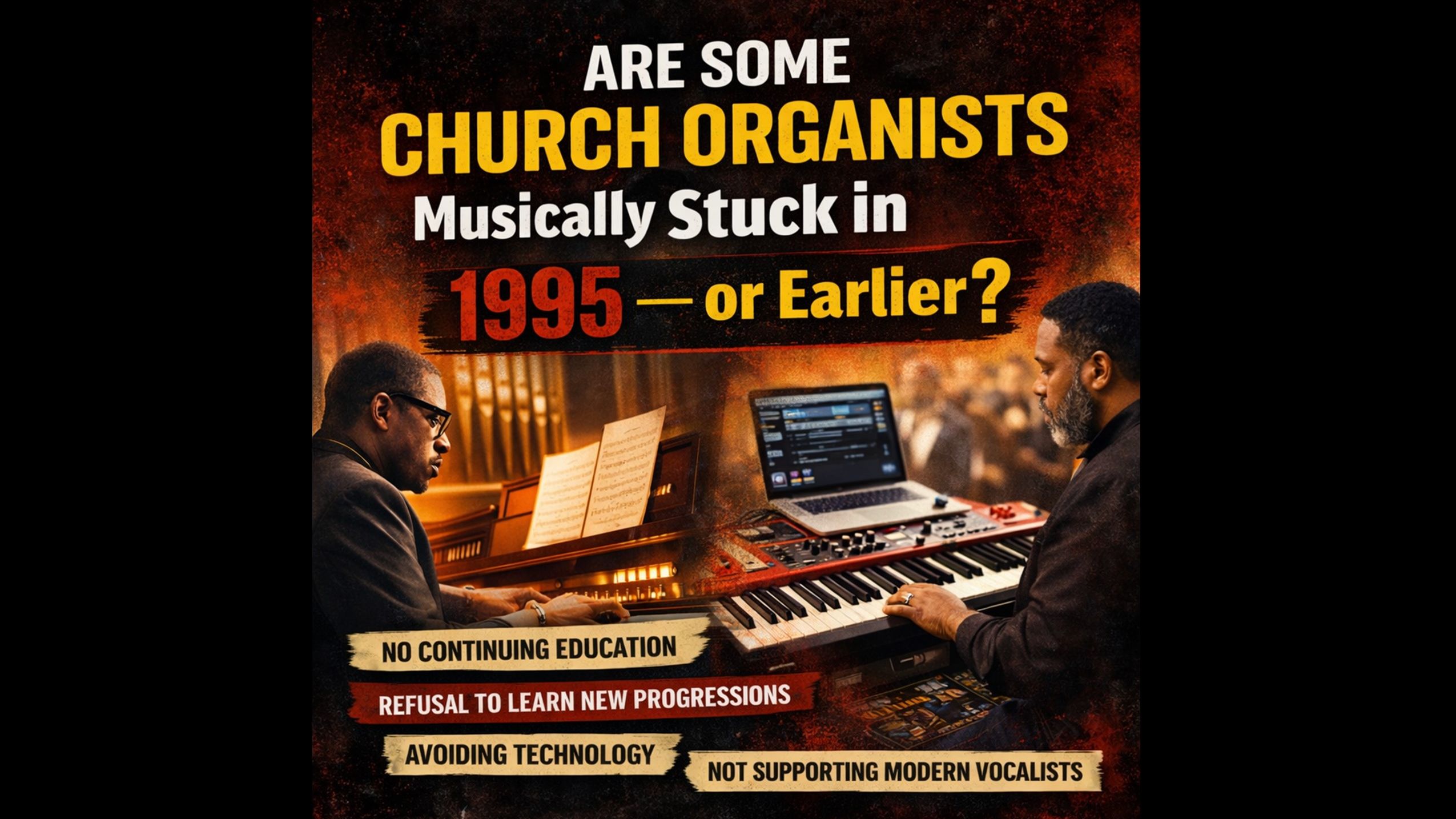
Let’s ask a bold question.
Is it possible that some church organists are musically stuck in 1995…
—or earlier?
This isn’t about attacking tradition.
It’s about asking whether growth is still happening.
Because while theology may remain constant, musical language evolves.
And when musicians stop evolving, the gap between generations widens.
1️⃣ The Continuing Education Gap
In most professions, development is expected.
But in church music, once someone is hired, growth often slows.
No new harmonic study.
No updated voicing exploration.
No exposure to emerging gospel styles.
No workshops.
No tech training.
If your musical vocabulary hasn’t expanded in 10–20 years, that’s not loyalty to tradition.
That’s stagnation.
Growth is a responsibility — especially in leadership roles.
2️⃣ Refusing to Learn New Progressions
Modern gospel has absorbed:
-
Neo-soul harmony
-
Jazz extensions and altered dominants
-
Modal interchange
-
Contemporary worship textures
-
Cinematic builds
Yet some organists default to:
-
The same 1-4-5 walk-ups
-
The same predictable turnarounds
-
The same modulation patterns
-
The same vamp structures
There’s nothing wrong with classic progressions.
But if they’re the only tools in the toolbox, we’re not leading — we’re looping.
3️⃣ Avoiding Technology
Let’s be honest.
Some musicians resist:
-
MIDI control
-
Click tracks
-
In-ear systems
-
Virtual B3 simulations
-
Layered pads
-
MainStage rigs
-
Even reviewing service recordings
Technology doesn’t replace musicianship.
It enhances clarity, precision, and flexibility.
Refusing to adapt isn’t protecting tradition —
it’s protecting comfort.
4️⃣ Not Understanding Modern Vocal Support
This may be the biggest issue.
Today’s vocalists approach gospel differently:
-
More dynamic control
-
Less constant shouting
-
More storytelling
-
More intentional phrasing
-
Controlled builds instead of immediate explosion
But some organists:
-
Overplay under verses
-
Fill every gap
-
Compete with the singer
-
Force emotional peaks too early
Modern accompaniment requires restraint.
Supporting the vocalist isn’t about volume —
it’s about sensitivity.
Tradition Is Powerful. Stagnation Is Not.
The Hammond B3 isn’t outdated.
Classic gospel language is sacred.
Foundation matters.
But refusing to grow?
That’s where tension begins.
There’s a difference between preserving heritage
and protecting habits.
The Real Question
If a 25-year-old musician joined your ministry today, would they see:
✔ Curiosity
✔ Musical evolution
✔ Openness
✔ Cross-generational awareness
Or would they see:
✖ Resistance
✖ Ego
✖ “We’ve always done it this way”
Excellence requires humility.
And humility keeps learning.
Why This Matters for DGMMV
Digital Gospel Music Master-Vault exists to:
• Bridge traditional and modern gospel
• Teach updated harmonic language
• Integrate technology wisely
• Strengthen accompaniment skills
• Develop leadership, not just players
Growth doesn’t erase legacy.
It strengthens it.
Final Thought
Being seasoned is valuable.
Being seasoned and still evolving?
That’s leadership.
The question isn’t whether you started in 1995.
The question is:
Are you still growing in 2026?